

Farming, Dairy
.jpg)
A spring drench strategically removes worms accumulated inside cattle over the cooler months. In this way, a Spring drench is often described as a 'clean up' drench. This will protect against weight loss over the season.
THE IMPORTANCE OF A SPRING DRENCH
A Spring drench strategically removes worms accumulated inside cattle over the cooler months. In this way, a Spring drench is often described as a ‘clean up’ drench. This will protect against weight loss over the season.
Research conducted by the NSW DPI and North Coast LLS with 245 mixed-breed steers, 9-11 months old, sourced from over 50 farms, found that young animals not treated effectively against worms were 15 kilograms lighter after 90 days.1
What worms do we target in Spring to avoid production loss?
Spring is a transitional time when temperatures are favourable for many worm species. Ostertagia, the most significant cattle worm, prefers cooler temperatures, so peak burdens are usually found over winter and early spring.2
- Ostertagia does not lay many eggs, so any detection in faecal testing can indicate a significant problem.
- Inadequate control of Ostertagia in young cattle can lead to losses of over 30kg during just one season.3
- In young breeders, poor Ostertagia control will majorly impact health and fertility.3
The hidden problem with Ostertagia
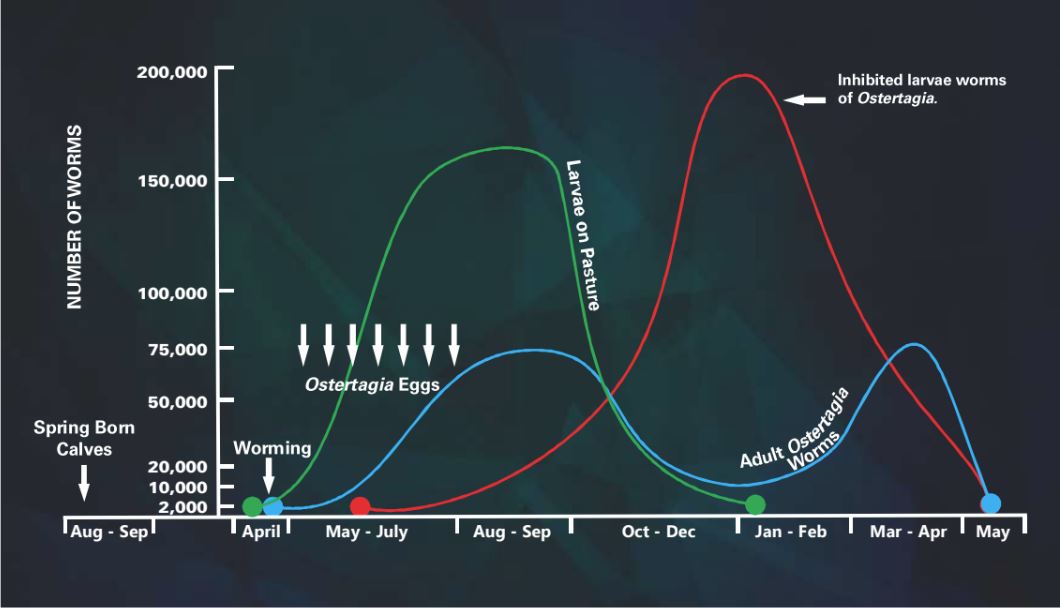
An important feature of Ostertagia is its ability to hide in the stomach lining during warmer months (inhibited larva).
The risks from Ostertagia follow a season pattern:
- In Autumn, young calves contaminate paddocks with large numbers of eggs. These eggs hatch and become immature larvae waiting in the paddocks to reinfest cattle. The number of these larvae peaks in late winter (green line)
- Cattle ingest larvae, and they grow up to become adults. Adult worms inside the cattle are peaking in early Spring. (blue line)
- As temperatures increase, some worms become inhibited by hiding in the stomach lining. This process begins in early Spring and peaks mid-summer (red line). These inhibited larvae will re-emerge in Autumn, and the cycle continues.
What do you need from Spring Drench?
A Spring Drench should ideally:
- Treat existing burdens with high efficacy
- Protect against new larval burdens for a few weeks
- Remove inhibited larva
Cydectin Platinum has 99-100% efficacy against existing worm burdens. On average, many other commonly used drenches are only 72% effective.4
Cydectin Platinum is the only combination drench with persistent activity. The persistent activity protects against new larval burdens and reduces pasture contamination for up to 35 days.5
Cydectin Platinum has a powerful action in treating inhibited worms. Some recently registered drenches, such as Dectomax V, lack a claim against inhibited Ostertagia.6 It is essential to control inhibited Ostertagia in all cattle less than two years of age.
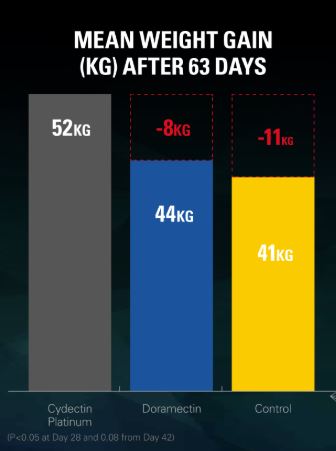
- 11kg compared to untreated cattle
- 8kg compared to Dectomax Pour On
REFERENCES:
1. The Australian Society for Parasitology (2014) Australasian Animal Parasites Inside Out. E-Textbook 2.Bullen et al. (2016), Anthelmintic resistance in gastrointestinal nematodes of dairy cattle in the Macalister District of Victoria, AVJ 94, 35-41. 3. Refer to the registered label (APVMA N 88072). Weight Gain is not a Cydectin Platinum Claim. 4. NSW DPI (2020) Duck Creek Endoparasite Trial Virbac Data on File.
This Spring, unlock all potential growth of your cattle
This Spring, use Cydectin Platinum becuase it is highly effective to clean out cattle of all worms, has the persistence to kill incoming worm larvae for longer, reduces the overall paddock contamination and protect the growth of your cattle on pasture.
The trial conducted by NSW DPI and North Coast LLS found that the use of Cydectin Platinum increased the growth of cattle over 63 days by: